
Why We Spec Open-Cell Spray Foam Insulation in Coastal Florida Homes
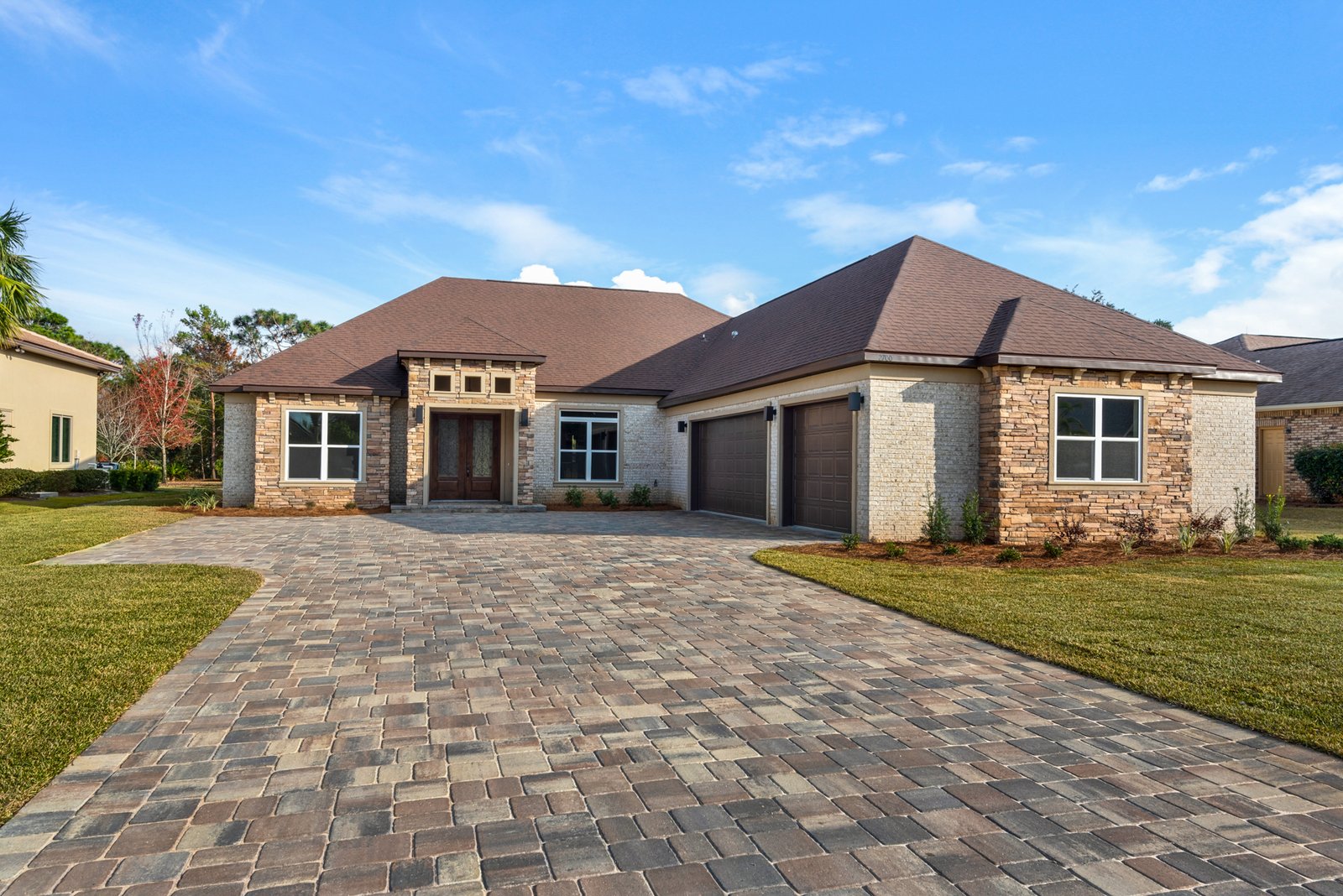
Most of our clients come to us already knowing they want a “well-built” home. What that means in practice — especially in Northwest Florida — comes down to a handful of specific construction decisions. One of the most important is what we put in the walls and under the roof deck.
We spec open-cell spray foam on most of our builds, even though it’s roughly twice the cost of traditional fiberglass batt. Here’s the reasoning.
Florida humidity is the problem fiberglass can’t solve
Walk into a 30-year-old Florida home with fiberglass batt insulation in the attic and you’ll usually find the same story: musty smell, ceiling stains in a few places, sagging insulation. The cause is almost always the same — humid air infiltrates the attic, finds cold surfaces, and the fiberglass batt acts like a sponge.
Fiberglass slows heat transfer (R-value), but it does almost nothing to stop air movement. In a coastal climate where outdoor air can be 90°F and 80% humidity for months at a time, an attic full of fiberglass is essentially a swamp generator sitting over your living space.
Open-cell spray foam does three things fiberglass can’t:
- Air sealing. Even though open-cell foam is permeable to vapor, it’s a fantastic air barrier. The foam expands roughly 100× its liquid volume into every gap, joint, and penetration. The same square-foot wall assembly with foam will leak roughly a tenth as much air as one with batts.
- Sound dampening. Open-cell’s softer cell structure absorbs sound waves remarkably well. This shows up in our finished homes as quiet rooms — conversations don’t carry, traffic noise disappears, bedrooms stay separated from the kitchen.
- Complete cavity fill. The high expansion rate means no voids, no settling, and no thermal bridging through gaps the way batts always have.
Why open-cell instead of closed-cell
Spray foam comes in two main varieties. Closed-cell foam is denser (~2 lb/cu ft), has a higher R-value per inch (~6.5), and acts as a vapor retarder at 2 inches thick. Open-cell foam is lighter (~0.5 lb/cu ft), has a lower R-value per inch (~3.7), and is vapor-permeable.
Closed-cell sounds better on a spec sheet. But in our conditioned-attic builds — where the whole envelope is sealed and climate-controlled — open-cell is almost always the smarter choice. Three reasons:
- Cost-per-benefit. Closed-cell runs roughly two to three times the per-board-foot price of open-cell. For the same R-value (just installed at greater thickness), open-cell delivers the air-seal that matters in this climate at a meaningfully lower cost.
- Vapor permeability is a feature, not a bug. In a conditioned attic in our climate, you want the roof assembly to be able to dry in both directions if it ever gets damp. A closed-cell vapor barrier traps moisture against the roof deck; open-cell lets the assembly breathe and stay dry.
- Sound performance. Open-cell’s softer structure outperforms closed-cell for sound dampening. For families with kids or anyone working from home, the quietness is the benefit they actually notice.
There are absolutely places we use closed-cell — rim joists, crawlspaces, below-grade walls, specific spot applications where its vapor-barrier and structural-reinforcement properties matter. But for the main wall-and-roof system on a residential build in this climate, open-cell wins on the merits.
What it does to the power bill
The hard part of building-science conversations is that the benefits aren’t visible. Nobody looks at an attic and says “wow, nice spray foam.” So let’s talk numbers.
On a typical 2,500-square-foot home in the Niceville–Navarre corridor, the difference between fiberglass and open-cell spray foam — when paired with a properly sized HVAC system and a conditioned attic — usually shows up like this:
- Cooling load drops 25–35%. We can spec a smaller HVAC unit, which saves a couple thousand dollars right there.
- Power bills in summer typically run $70–$130/month lower compared to a comparable batt-insulated home.
- HVAC equipment lifespan is usually 20–30% longer because the unit isn’t running constantly.
- Net payback on the foam premium: most of our clients break even in 5–8 years on utility savings alone, before you count equipment replacement.
That math gets even better as electricity rates rise — and Florida rates have not been trending down.
What it does for hurricanes
Hurricane Ivan, Hurricane Sally, and Hurricane Michael all reshaped how Florida builders think about coastal homes. Where closed-cell foam adds direct shear strength to wall assemblies, open-cell’s contribution is more about air-sealing the envelope so wind-driven rain can’t intrude through small leaks. That matters — most “hurricane damage” claims trace back to water infiltration after the wind event, not the wind itself.
Spray foam (either type) is never a substitute for proper hurricane straps, impact-rated windows, or a code-compliant roof system — those are non-negotiable on our builds. But a well-sealed envelope is a third line of defense.
What it does for sound
This is the surprise benefit clients always mention after move-in. Open-cell-foamed homes are quiet. Conversations don’t carry from one end of the house to the other. Bedrooms don’t share noise with the kitchen. Outdoor traffic, neighbors, and weather basically disappear. For families with young kids or anyone who works from home, the difference is genuinely noticeable.
This is the area where open-cell actually outperforms closed-cell, because softer foam absorbs more sound energy than denser foam.
When we don’t recommend it
Foam isn’t right for every project. Specifically:
- Tight budgets where foundation and roof systems still need work — better insulation can’t compensate for a leaky building envelope. If we have to choose, we fix the envelope first.
- Vented attic designs where the attic is intentionally outside the conditioned envelope. Open-cell in a hot, humid vented attic can cause moisture problems; this is one of the few cases where we’d switch to closed-cell or stay with fiberglass at the ceiling plane.
- Garage-only or detached structures — usually not worth the premium.
For everything else — primary residence, climate-controlled, conditioned attic, long-term hold — open-cell foam is what we put in our own homes. So it’s what we put in yours.
How to ask your builder about insulation
If you’re shopping builders, here are the questions to ask about insulation that will tell you a lot about how they think:
- “What’s the R-value of the wall and roof assemblies you spec, and how did you arrive at it?”
- “How are you handling air sealing at top plates, rim joists, and penetrations?”
- “Is the HVAC system sized using Manual J based on the actual building envelope, or off a rule of thumb?”
- “What’s your stance on conditioned-attic versus vented-attic construction in this climate?”
- “If you use spray foam, why open-cell or closed-cell for this particular assembly?”
The right answers won’t all be “spray foam” — there are good reasons to use other systems in specific scenarios. But the way a builder answers will tell you whether they understand building science or are just installing what’s cheapest.
If you want to talk through the specs of a build we’re working on, or you’re trying to compare proposals from different builders and need a second opinion, give us a call.
Talk with us about your project.
Have questions about anything in this post? Reach out — we'd love to hear what you're planning.
Contact Avant Home Builders